Why Political Podcasts Matter for Civic Engagement
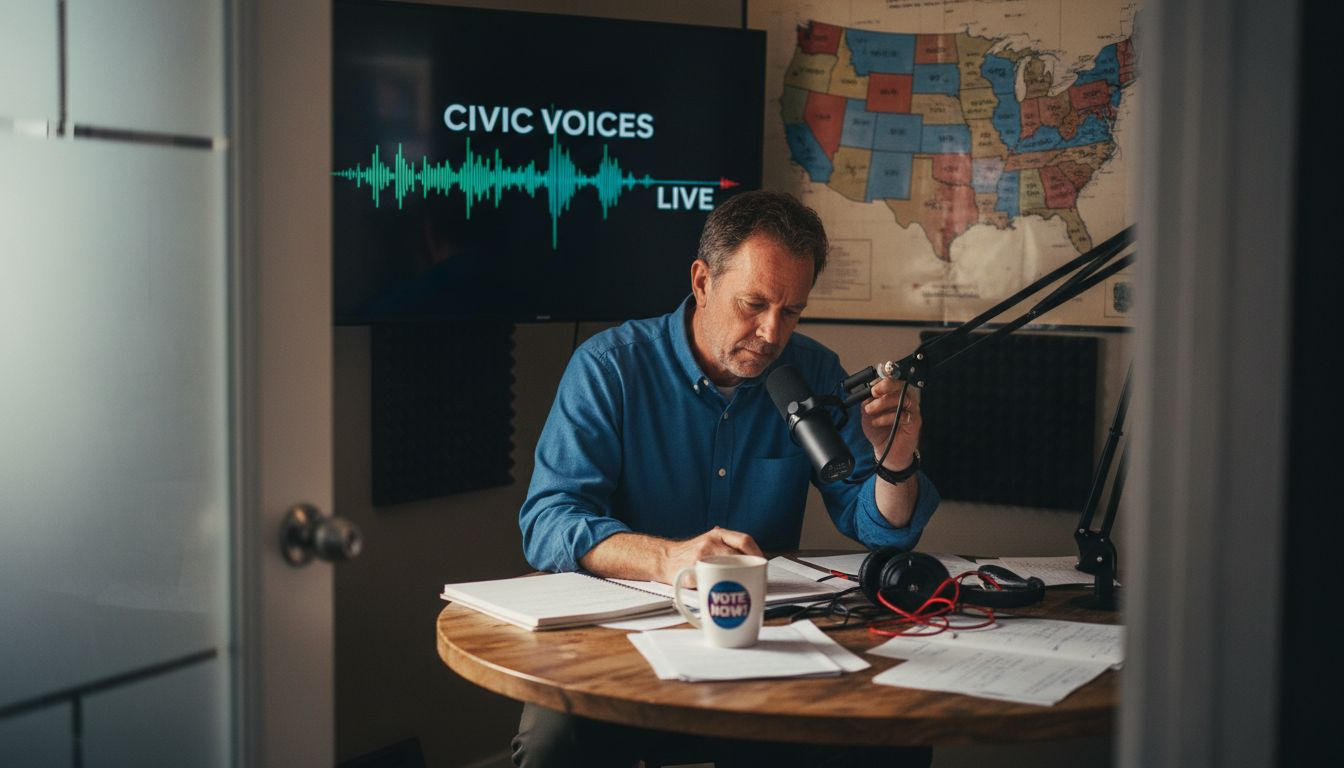
More than half of American adults now turn to podcasts for news and analysis, reflecting a dramatic shift in how political information is consumed. As digital audio platforms reshape global discourse, listeners gain direct access to nuanced discussions and historical context often missing from traditional media. This article highlights the strengths and pitfalls of political podcasts, revealing how they engage audiences, foster civic participation, and influence public opinion across borders.
Table of Contents
Key Takeaways
Point | Details |
Diversity of Perspectives | Political podcasts allow for a wide range of voices and viewpoints, encouraging a more nuanced understanding of political issues. |
Engagement and Interactivity | Many podcasts engage listeners through live discussions and social media, making political discourse more accessible. |
Innovation in Political Communication | Podcasts provide in-depth explorations of political topics, challenging traditional media formats and facilitating personalized political education. |
Critical Consumption Required | Listeners must develop media literacy skills to navigate potential misinformation and bias in podcast content. |
Defining Political Podcasts and Their Purpose
Political podcasts are digital audio or video programs that explore complex political landscapes, current events, and policy discussions through episodic content. These platforms have emerged as powerful communication tools that enable direct public discourse beyond traditional media channels. Unlike conventional news broadcasts, political podcasts offer audiences more intimate, in-depth explorations of political themes through conversational and narrative-driven formats.
At their core, political podcasts serve multiple critical functions in modern civic engagement. They democratize political information by providing accessible platforms where experts, journalists, activists, and citizens can discuss nuanced political issues. Podcast formats range from structured interviews and panel discussions to more casual, conversational roundtables that break down complex political topics into digestible narratives. These programs help listeners understand policy implications, track legislative developments, and gain insights into political strategies that might otherwise remain obscure.
The digital nature of political podcasts fundamentally transforms how political information is consumed and shared. Digital communication platforms enable podcasters to reach global audiences instantly, transcending geographical and institutional boundaries. This accessibility means that listeners can engage with political content on their own schedules, creating more flexible and personalized political education experiences. Political podcasts also provide space for diverse perspectives, allowing marginalized voices and alternative viewpoints to enter mainstream political discourse.
Pro tip: When exploring political podcasts, seek out programs that feature multiple perspectives and provide evidence-based analysis rather than pure partisan rhetoric.
Types and Formats of Political Podcasts
Political podcasts represent a diverse media ecosystem with multiple content formats designed to engage audiences through different storytelling approaches. Podcast formats range widely, including interview-based programs, solo commentary shows, roundtable discussions, narrative storytelling series, and investigative journalism episodes. These diverse formats allow political communicators to explore complex topics through varied lenses, providing listeners with nuanced perspectives on contemporary political landscapes.
Interview-based podcasts represent one of the most popular formats, featuring in-depth conversations with political experts, lawmakers, journalists, and activists. These programs typically involve one or more hosts engaging guests in structured dialogues that unpack policy issues, electoral dynamics, and current political developments. Other formats like roundtable discussions bring together multiple perspectives simultaneously, creating dynamic conversations that simulate real-world political discourse. Digital communication platforms have enabled these podcasts to reach global audiences, transcending traditional media limitations.
Narrative storytelling and investigative podcasts offer another compelling approach to political communication. These formats often use long-form storytelling techniques, presenting deep dives into specific political issues, historical events, or systemic challenges. Such podcasts may feature carefully researched episodes that blend personal narratives, archival materials, expert interviews, and critical analysis. By humanizing complex political topics, these narrative approaches make political information more accessible and emotionally resonant for diverse audiences.
Pro tip: Explore podcasts across different formats to develop a more comprehensive understanding of political topics and perspectives.
Here’s how major political podcast formats differ in approach and audience engagement:
Format Type | Typical Content Style | Audience Engagement | Ideal For |
Interview-Based | Expert discussions, structured Q&A | Listener questions, social media feedback | Deep policy understanding |
Roundtable | Multiple perspectives, debate | Live sessions, group forums | Broader viewpoint analysis |
Narrative Storytelling | Personal stories, historical context | Emotional connection, narrative immersion | Policy context, empathy |
Investigative | In-depth investigations, exposés | Extended episodes, exclusive findings | Policy impacts, uncovering issues |
How Political Podcasts Enable Direct Engagement
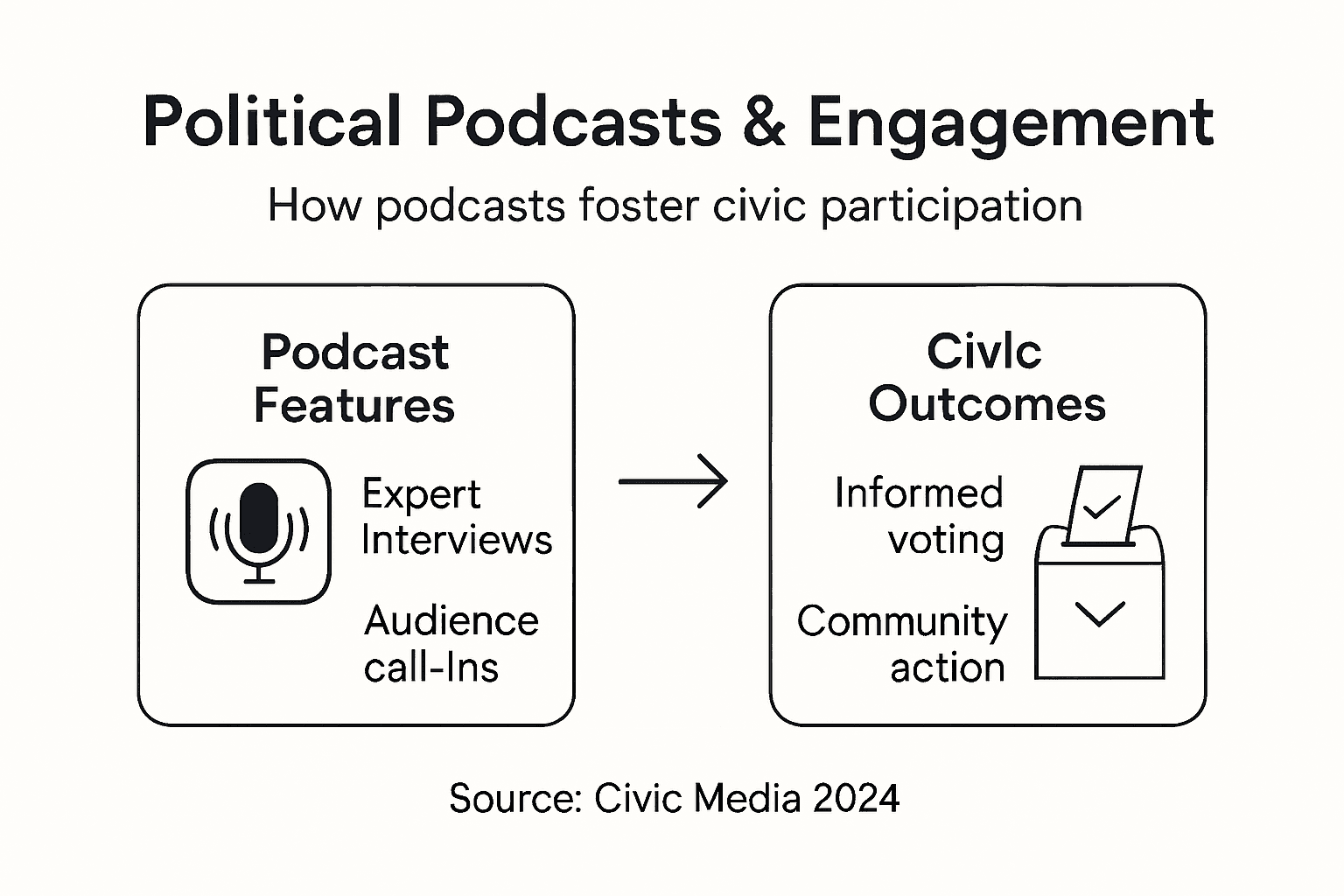
Political podcasts have revolutionized citizen participation by creating unprecedented opportunities for direct political communication, breaking down traditional barriers between political experts and the general public. These digital platforms provide an intimate, conversational medium where complex political issues can be explored in depth, allowing listeners to engage with nuanced perspectives that traditional media often overlook. By offering unfiltered access to political discussions, podcasts transform passive information consumption into an active learning experience.
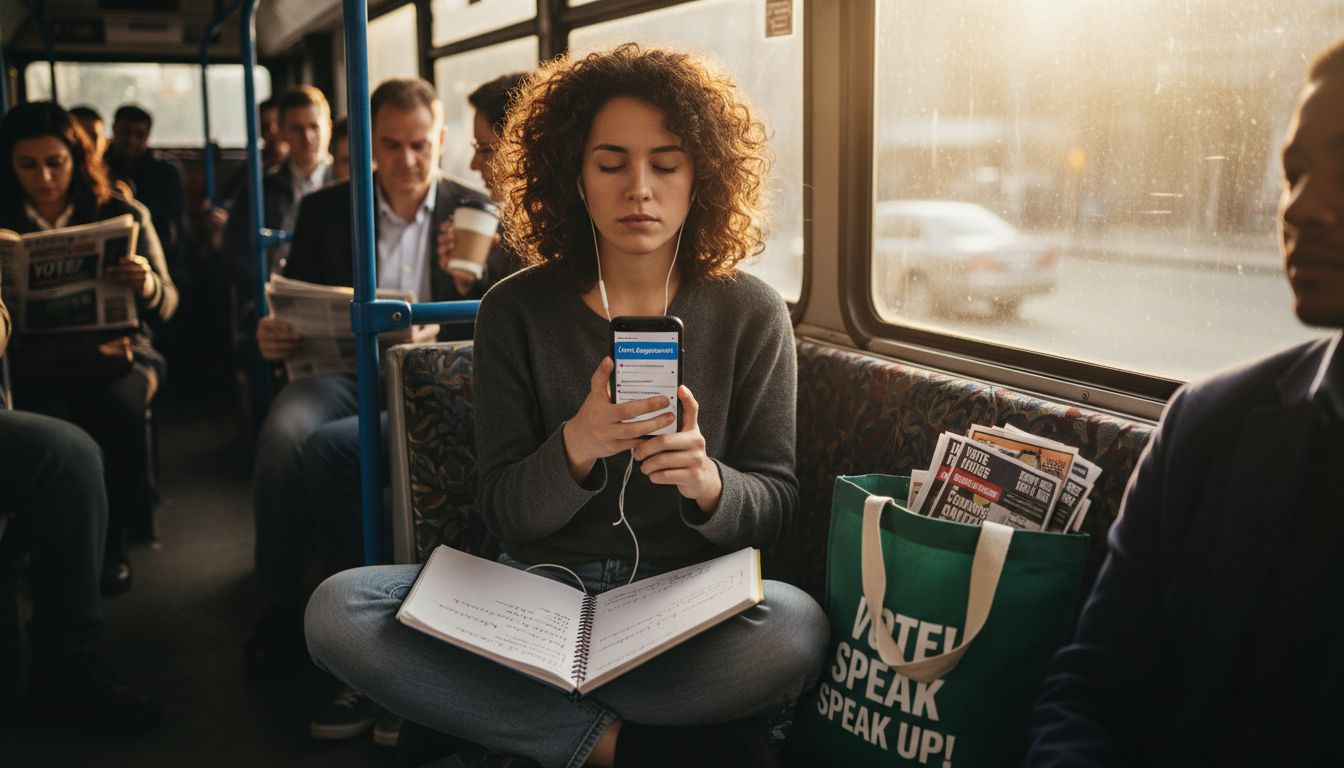
The interactive nature of political podcasts extends beyond mere listening. Many podcasts now incorporate audience engagement strategies such as live Q&A sessions, social media interactions, and community discussion forums. Listener participation becomes a critical component of the political discourse, enabling individuals to ask questions, challenge ideas, and contribute their own perspectives. Facilitated dialogue networks have demonstrated how podcast-driven conversations can foster empathy, respect, and deeper understanding among listeners with diverse political backgrounds.
Moreover, political podcasts democratize access to political information by humanizing political figures and policy discussions. They provide platforms for marginalized voices, independent journalists, and grassroots activists to share insights that might be marginalized in mainstream media. By presenting personal narratives, expert analyses, and contextual discussions, these podcasts help listeners develop more nuanced understandings of political complexities, ultimately empowering them to become more informed and engaged citizens.
Pro tip: Choose podcasts that feature diverse perspectives and encourage critical thinking about political issues.
The Influence of Podcasts on Public Opinion
Political podcasts have emerged as powerful instruments of public opinion formation, offering nuanced perspectives on complex issues that traditional media channels often struggle to communicate. Unlike conventional news sources, podcasts provide in-depth explorations of political topics, allowing listeners to develop more sophisticated understandings of contemporary political landscapes. Their long-form format enables hosts and guests to unpack multifaceted political narratives, challenging simplistic narratives and encouraging critical thinking among audiences.
The emotional resonance of political podcasts plays a crucial role in shaping public perception. Storytelling techniques allow podcasts to humanize political discussions, transforming abstract policy debates into compelling personal narratives that connect with listeners on a deeper level. Podcast audiences in urban contexts have demonstrated how sonic aesthetics and collaborative storytelling can create powerful affective connections that influence political understanding and engagement.
Moreover, political podcasts provide a platform for diverse voices and perspectives that might be marginalized in mainstream media. By featuring interviews with experts, activists, grassroots organizers, and individuals directly impacted by political policies, these podcasts broaden listeners’ understanding of complex social and political issues. They challenge listeners to move beyond partisan echo chambers, encouraging more nuanced and empathetic political discourse that recognizes the complexity of contemporary political challenges.
Pro tip: Actively seek out podcasts that present multiple perspectives and challenge your existing political assumptions.
Challenges: Misinformation and Bias in Podcasts
Political podcasts face significant challenges in maintaining credibility, with disinformation tactics increasingly threatening the integrity of digital political discourse. These platforms are particularly vulnerable to manipulation, as their conversational and intimate format can make listeners more susceptible to persuasive narratives that may not be thoroughly fact-checked. Bad actors can exploit the medium’s perceived authenticity, spreading misleading or completely false information under the guise of insider knowledge or expert analysis.
Media literacy becomes crucial in navigating the complex landscape of political podcasts. Political misinformation studies reveal that partisan platforms often intentionally spread biased content, creating echo chambers that reinforce existing beliefs rather than promoting critical thinking. Some podcasts deliberately use tactics like selective storytelling, emotional manipulation, and cherry-picked evidence to shape listener perceptions, making it essential for audiences to develop robust critical evaluation skills.
The challenges extend beyond intentional misinformation to more subtle forms of bias. Podcast hosts may unconsciously introduce personal prejudices, present incomplete contextual information, or rely on unchallenged assumptions that can significantly skew listener understanding. This subtle form of bias can be more dangerous than overt misinformation because it appears more nuanced and credible. Listeners must learn to recognize these subtle manipulation techniques, cross-reference information from multiple sources, and maintain a healthy skepticism toward any single narrative presented in a podcast.
Pro tip: Always cross-reference podcast information with multiple credible sources and maintain a critical, questioning mindset while listening.
Comparing Podcasts to Traditional Media Channels
Political podcasts represent a radical departure from traditional media channels, offering unprecedented digital media experiences that challenge conventional information consumption patterns. Unlike scheduled television broadcasts or print newspapers, podcasts provide on-demand, personalized political content that listeners can access anytime, anywhere. This flexibility fundamentally transforms how individuals engage with political information, breaking down temporal and geographical barriers that have long restricted media consumption.
The decentralized media landscape of podcasts contrasts sharply with traditional media’s hierarchical structures. Podcast platforms democratize political discourse by removing traditional gatekeeping mechanisms, allowing diverse voices and perspectives that might be marginalized in mainstream media to find audiences. While traditional news outlets often require significant infrastructure and financial investment, podcasts can be produced with minimal resources, enabling independent journalists, activists, and political commentators to create and distribute content directly to interested listeners.
Moreover, podcasts offer a more intimate and conversational approach to political communication compared to traditional media’s often formal and detached reporting styles. The long-form, in-depth nature of many political podcasts allows for nuanced discussions that go beyond sound bites and surface-level analysis. This format enables listeners to gain deeper insights into complex political issues, hear multiple perspectives, and engage with content in a more reflective and comprehensive manner than traditional media typically permits.
This table highlights key differences between podcasts and traditional media for political information:
Feature | Political Podcasts | Traditional Media |
Accessibility | On-demand, global | Scheduled, local/national |
Perspective Diversity | High, many voices | Limited, editorially filtered |
Depth of Discussion | Long-form, detailed | Short, surface-level |
Interactivity | Listener feedback, forums | Minimal, one-way delivery |
Pro tip: Diversify your media diet by combining podcast content with traditional news sources to develop a more comprehensive political understanding.
Discover How Thoughtful Political Podcasts Can Deepen Your Civic Engagement
Political podcasts offer a unique chance to break through the noise and engage with complex political realities on a personal level. If you are seeking in-depth analysis, diverse perspectives, and a way to cut through misinformation and bias, you understand the challenge of finding trustworthy political content that truly informs and empowers. This article highlights the importance of podcasts for direct public discourse and active citizen participation, a goal that aligns closely with the thoughtful political commentary and literary work available on Oscar Bellina Lishner’s platform.

Explore original podcasts and articles that challenge assumptions and encourage critical thinking about history, geopolitics, and social issues. Don’t miss the opportunity to hear diverse voices and sophisticated insights that promote a more nuanced understanding of today’s political landscape. Visit Oscar Bellina Lishner’s official site now to deepen your political engagement through compelling commentary and media. Engage with content that moves beyond partisan rhetoric and equips you to participate more meaningfully in civic life.
Frequently Asked Questions
What are political podcasts, and why are they important?
Political podcasts are digital audio or video programs that explore political topics, current events, and policy discussions. They provide accessible platforms for public discourse, democratizing information and allowing diverse voices to contribute to political conversations.
How do political podcasts facilitate civic engagement?
Political podcasts create opportunities for direct political communication, allowing listeners to engage with complex issues in depth. They promote active learning and participation through audience interactions, making these platforms essential for fostering informed citizens.
What types of formats do political podcasts use?
Political podcasts utilize various formats, including interview-based shows, roundtable discussions, narrative storytelling, and investigative journalism. Each format offers unique strengths in presenting political content, allowing listeners to gain nuanced insights into complex issues.
How can I discern bias or misinformation in political podcasts?
Listeners should develop media literacy skills to identify potential bias and misinformation. Cross-referencing information from multiple credible sources and maintaining a critical mindset while listening can help mitigate the risk of being misled by partisan narratives.
Recommended

Comments